I've written periodically about the immigration case backlog. Syracuse University's backlog tool has detailed numbers. Right now (at least as of June 2014, with the fiscal year ending at the end of September) the total number of backlogged cases is 375,503. Of particular note is the fact that Central America is already high on that list. Here are the five countries with the most:
Mexico: 124,408
El Salvador: 48,319
Guatemala: 40,807
Honduras: 36,842
China: 26,969
This of course is why President Obama is seeking emergency money for judges. There is no possible way the children currently here (and the more arriving) can even get in front of a judge for a long time. The average number of days to wait is 587. He is asking for 40 judges (in addition to 35 in his regular budget request), which really seems inadequate. Some is better than none, but how much will that decrease the wait? The administration provides an estimate that each judge will decrease the caseload by about 1,000 per judge per year. That requires the judge to do almost three cases a day, 365 days a year. Once you insert weekends, federal holidays, vacation time, snow days, etc. it seems a stretch. Cases involving children also take longer.
And the backlog gets worse and worse--it has skyrocketed under Obama, which is more evidence that he has been enforcing the law aggressively despite efforts to claim the opposite.
2009: 223,809
2010: 262,799
2011: 297,551
2012: 325,044
2013: 344,230
2014: 375,503 (and counting)
Thursday, July 17, 2014

2008 Trafficking Law and Unaccompanied Minors
Increasing attention is being paid to the "William Wilberforce Trafficking Victims Protection Reauthorization Act of 2008," signed into law by George W. Bush. I note that primarily because it was signed back at basically the last moment that immigration policy was bipartisan. Once President Bush left office, it disappeared.
Republicans want to amend the law to speed up the processing and removal of the children currently in the United States. As it stands, only children from contiguous countries are processed quickly. Since the surge of children is coming from Central America, they go under the authority of the Department of Health and Human Services, getting hearings and staying with families (sometimes their own) while they await a final decision. They get an immigration judge rather than a border patrol agent. That is why the Obama administration is asking to hire more judges, which are in embarrassingly short supply.
That is potentially a reason for the surge--word has spread that if children arrive in the United States, they are not immediately deported. As with other potential reasons, it suffers from timing--if the law was passed in 2008, why would it take six years for a surge? But it's possible.
But what should we do? There is evidence that from a humanitarian perspective, it's a mistake to treat Central American children like their Mexican counterparts. From Dara Lind (who has been writing a lot of interesting stuff at Vox):
It's a rushed, confused process that would become more even chaotic given the numbers we're dealing with. I tend to agree that we should treat children the same, but we should take the most humane approach, not the least.
Republicans want to amend the law to speed up the processing and removal of the children currently in the United States. As it stands, only children from contiguous countries are processed quickly. Since the surge of children is coming from Central America, they go under the authority of the Department of Health and Human Services, getting hearings and staying with families (sometimes their own) while they await a final decision. They get an immigration judge rather than a border patrol agent. That is why the Obama administration is asking to hire more judges, which are in embarrassingly short supply.
That is potentially a reason for the surge--word has spread that if children arrive in the United States, they are not immediately deported. As with other potential reasons, it suffers from timing--if the law was passed in 2008, why would it take six years for a surge? But it's possible.
But what should we do? There is evidence that from a humanitarian perspective, it's a mistake to treat Central American children like their Mexican counterparts. From Dara Lind (who has been writing a lot of interesting stuff at Vox):
It's not that Border Patrol agents aren't sympathetic to the plight of Mexican children — indeed, they're personally very kind to the children in their care. But the secret report shows that Border Patrol agents simply don't know what to look for to figure out if a child is being victimized, or what to do if he or she is.
It's a rushed, confused process that would become more even chaotic given the numbers we're dealing with. I tend to agree that we should treat children the same, but we should take the most humane approach, not the least.
Wednesday, July 16, 2014
Unaccompanied Minors and Causation
The puzzle over the surge of unaccompanied minors is tied directly to the difference between correlation and causation. The essential problem is understanding the surge. On one side--usually associated with the Republican Party--the argument is that President Obama's promises about deferred action acted as a catalyst. From Senator Ted Cruz:
Is it really your testimony that granting amnesty to some 800,000 people who came here illegally as children had no effect in causing a dramatic increase of children being handed over to international drug cartels to be smuggled in here illegally?
There are problems with that when we start trying to move from correlation to causation.
Border Patrol statistics, depicted above, show that arrivals of unaccompanied Central American children began increasing during U.S. fiscal year 2012, which ran from October 2011 to September 2012. DACA was not announced until June 2012. Immigration reform legislation had not yet been proposed, and the review of deportation procedures was far off. In fact, in 2012 the Obama administration broke the United States’ single-year record for deportations of undocumented foreign citizens (409,849 people): hardly a welcoming message for would-be migrants.
Second, there is no evidence that immigrants knew about DACA at all. From Elizabeth Kennedy, who was doing fieldwork:
“The rumors did not start until Obama called it an urgent humanitarian situation,” she said. “In over 300 interviews, only one asked about DACA [Deferred Action for Childhood Arrivals]. Otherwise, no one ever named any specific U.S. legislation. Some asked if children should lie about their age and say they were over 18.”
Third, if rumors about DACA are rampant, why are there so few sending countries? From federal officials:
Federal officials have said that if migrants were coming to the U.S. because of the DACA program, there would be many more families arriving from countries other than Honduras, El Salvador and Guatemala — such as India and China — to also take advantage of the program.
There is no surge from Mexico, for example, which makes no sense if this logic is to hold. Incentives like DACA would spread southward through Mexico, yet somehow affect only Central America.
On the other side of the debate, violence in Central America is blamed. From Tom Wong:
Violence is among of the main drivers causing the increase. Whereas Central American countries that are experiencing high levels of violence have seen thousands of children flee, others with lower levels of violence are not facing the same outflow.
He equates "violence" with "homicide." Mike Allison notes that homicide rates have actually improved so cannot explain a surge, and attributes emigration to gang violence instead:
What seems to be a better explanation for what is driving people to leave their homes is the threat from the Mara Salvatrucha (MS-13) and 18th Street gangs that have been operating in Central America for two decades. Violence worsened in the 2000s when governments adopted mano dura ("strong hand") security policies rather than investing in social programmes, education, and gang prevention and rehabilitation strategies. Regional drug cartels and gangs have grown increasingly powerful as the region has become a much more important transit point for drugs.
This is really hard to measure, though. If the "mano dura" approach was taken a decade or so ago, how do we explain the lag?
Correlation is easy to find, causation much harder. I probably buy Mike's hypothesis more than any other, but even then I would have to see more data to be convinced. It's a sad, tragic, and still largely unexplained phenomenon.
Tuesday, July 15, 2014
U.S. Occupation of Cuba
On September 14, 1906 President Theodore Roosevelt informed the Cuban foreign minister that he did not think they were capable of governing themselves and so invoking the Platt Amendment he was sending William Howard Taft to clean things up. It's quite an insulting message, as you would expect, though of course couched in terms of how much he wants the country to be independent.
"For there is just one way in which Cuban independence can be jeoparded, and that is for the Cuban people to show their inability to continue in their path of peaceful and orderly progress."
Replace "Cuba" with Chile, Guatemala, Panama you name it, and it's almost like a motto of U.S. foreign policy.
Here it is from FRUS:


I will be including this collection of digitized FRUS pages on Cuba for the "further sources" part of my U.S. and Latin American Relations 2nd edition textbook chapter that covers the first third of the 20th century. The University of Wisconsin has a lot of stuff digitized that is not on the State Department's own website.
"For there is just one way in which Cuban independence can be jeoparded, and that is for the Cuban people to show their inability to continue in their path of peaceful and orderly progress."
Replace "Cuba" with Chile, Guatemala, Panama you name it, and it's almost like a motto of U.S. foreign policy.
Here it is from FRUS:
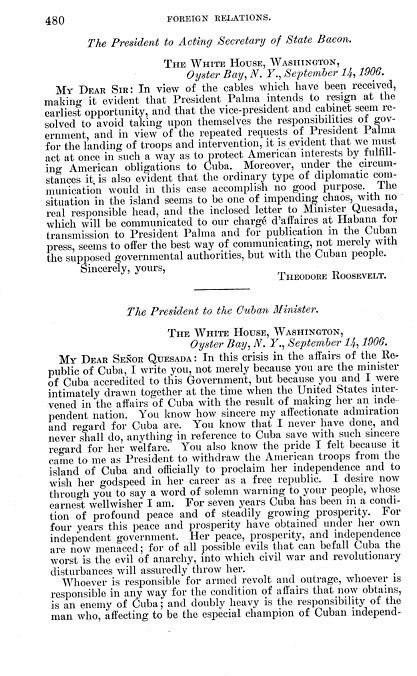
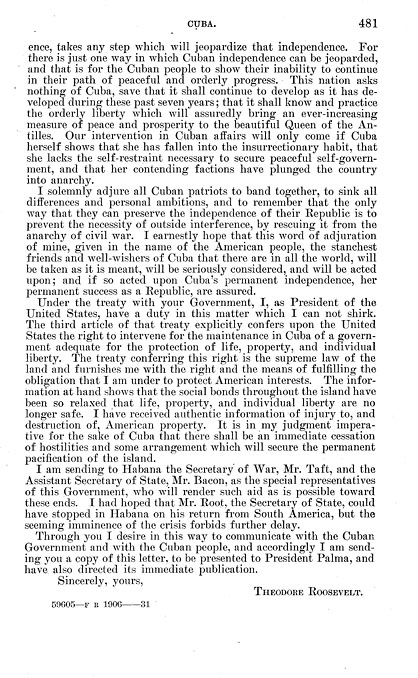
I will be including this collection of digitized FRUS pages on Cuba for the "further sources" part of my U.S. and Latin American Relations 2nd edition textbook chapter that covers the first third of the 20th century. The University of Wisconsin has a lot of stuff digitized that is not on the State Department's own website.
Monday, July 14, 2014
Luis Vicente Leon on Venezuela Sanctions
David Smilde translates Luis Vicente Leon's comments on potential Venezuela sanctions from a WOLA (Washington Office on Latin America) event. If you want a really good, concise argument about why they are a bad idea, then you've got it.
Using poll data, he shows that Venezuelans see the sanctions as an excuse for the United States to meddle and force regime change. Leon sees the sanctions stemming in large part from legitimate concerns mixed with a typical election-year gimmick in anti-Chavista Florida districts, but Venezuelans are understandably suspicious of U.S. motives.
The money quote:
This sentiment is exactly the same as the post I wrote about President Obama's approach to foreign policy, which involves a credo of "don't do stupid shit." Unfortunately, for a variety of reasons the chances are good we will.
Using poll data, he shows that Venezuelans see the sanctions as an excuse for the United States to meddle and force regime change. Leon sees the sanctions stemming in large part from legitimate concerns mixed with a typical election-year gimmick in anti-Chavista Florida districts, but Venezuelans are understandably suspicious of U.S. motives.
The money quote:
Taking the individual route of Big Brother usually ends up being a Big Mistake, or as Marino Alvarado of Provea says, an own goal from midfield.
This sentiment is exactly the same as the post I wrote about President Obama's approach to foreign policy, which involves a credo of "don't do stupid shit." Unfortunately, for a variety of reasons the chances are good we will.
Friday, July 11, 2014
Admitting Immigration Failure
Boz makes an excellent point here about the well-intentioned ad campaign to let would-be migrants in Central America and Mexico know that the journey is too dangerous to undertake. What it indicates is policy failure--that journey actually shouldn't be that dangerous.
I would take this a step further and note some specific ways that specific policies have failed:
--the Immigration Reform and Control Act had as an explicit goal the regularization of immigration, thus greatly reducing illegal border crossing.
--NAFTA was explicitly framed as something that would reduce migration. I don't recall off the top of my head whether the CAFTA debate was quite so emphatic in that regard but its logic is obviously similar.
--the War on Drugs (or whatever you want to call it) was explicitly intended to reduce drug-related violence.
--the Obama administration's response to the 2009 coup in Honduras was explicitly phrased as helping to bring democracy and stability to the country.
This doesn't mean all these policies (or elements of them) are bad or that there was a magic answer to the problem. But it does mean that collectively we need to figure out why they failed and how to improve them.
Thursday, July 10, 2014
U.S. and Latin American Relations writing (part 9)
It's been a while since I've updated but I've made tons of progress, to the point that I don't need to think in terms of chapter goals anymore. Every existing chapter has been revised and I've completed a draft of the new chapter (on the challenge to hegemony) that I am now attacking with a pen. There is more work to do but it is doable--it involves finding another book or two for suggested additional readings to replace old ones that perhaps are dated; making some additions to the chapter timelines; going over sources, especially internet ones that disappeared or changed (my thanks to those websites that did not change over what was sometimes 10 years since I last referenced them!); cleaning up footnotes; and checking a few facts for updates (like ratification of treaties/agreements).
In short, I will have this book manuscript submitted by the end of this month. What I hope is that the final book is ready for adoption for Fall 2015 classes. But what authors hope for books and what happens rarely match (for me, they have never matched). There are all sorts of unexpected delays and that's just the way it is. For my recently published Understanding Latin American Politics book among other things I spent months dealing with permissions issues. It was maddeningly slow but it had to be done right. I was sent long Excel spreadsheets that I had to read and comment on, which sometimes entailed changing or deleting content because a permission just couldn't be obtained.
In short, I will have this book manuscript submitted by the end of this month. What I hope is that the final book is ready for adoption for Fall 2015 classes. But what authors hope for books and what happens rarely match (for me, they have never matched). There are all sorts of unexpected delays and that's just the way it is. For my recently published Understanding Latin American Politics book among other things I spent months dealing with permissions issues. It was maddeningly slow but it had to be done right. I was sent long Excel spreadsheets that I had to read and comment on, which sometimes entailed changing or deleting content because a permission just couldn't be obtained.
Subscribe to:
Posts (Atom)