Showing posts with label Cuba. Show all posts

Monday, October 13, 2014

Arguing the Cuban Embargo

Car Service New York and Limo Service New York provided by NYCairportsLimo.com from Manhattan to Upstate New York, Westchester, Long Island, Nassau, Suffolk, New Jersey, Pennsylvania and Connecticut. NYC Airports Limo use limos and luxury cars for New York Car Service from Manhattan to John F. Kennedy, LaGuardia, EWR, Philadelphia and Long Island MacArthur Airport. NYCairportsLimo is specializing in Airport Car Service from Brooklyn, Queens, Bronx and Staten Island to JFK, LGA, EWR, HPN, ISP and PHL Airports.

Limousine Service in CT and Car Service in CT are provided by CTairlink in Brooklyn, Bronx, Queens, Staten Island, Manhattan to JFK, LaGuardia and Newark Liberty Airports. CT Airlink use Luxury Vans, Sedans, SUVs, Shuttles and Motor Buses for Limousine Service CT and Limo Service in Connecticut including Manhattan Cruise Terminal in NY, Brooklyn Cruise Terminal - New York, Bayonne Cruise Terminal in NJ, Atlantic City Casinos - New Jersey, Mohegan Casino and Foxwoods Casino in Connecticut by CT Airlink Limo.

Carlos Alberto Montaner explains why the United States should maintain the embargo and not normalize relations with Cuba. It rests on four pillars, which are so easily undercut that the logic topples down.

1. We can't do so because Cuba on the state sponsor of terrorism list. I see. Well, since it is well documented that Cuba shouldn't be on the list, then just take them off. North Korea isn't even on it.

2. Cuban American members of Congress speak for every single Cuban American in the country, and they like the embargo, so it should stay. I am not joking--he really argues this. Discard.

3. Cuba actively tries to undermine the interests of the United States. If so, it's quite bad at it. I can't think of anything the U.S. has done for many years that the Cuban government has been able to undermine.

4. Normalizing relations would signal to the Cuban government that they don't need to reform. The problem with this argument is that the embargo sends that message even more strongly. If anything, normalizing gives the Cuban opposition more space--especially economically--than they would otherwise have.

Wednesday, October 1, 2014

Kissinger and Cuba

Henry Kissinger wanted to attack Cuba in 1976 because Fidel Castro invaded Angola (here is the link to the documents at the National Security Archive--as always, the documents are fascinating). This is all coming from the new book by Peter Kornbluh and William LeoGrande new book, Back Channel to Cuba, which looks great.

There is so much here. It's Henry Kissinger in all his glory, with threats, exaggerations, and vanity. Some things in particular struck me.

First, Kissinger was offended that Cuba invaded just as the U.S. was negotiating better relations, and he couldn't understand it. This reminded me of Nicolás Maduro, where suddenly he'll shift from "I want to improve relations" to kicking some U.S. official out. In fact, Castro did not and Maduro does not want fully normalized relations because it removes an important domestic foil for them.

Second, in all of the talks about normalization, the Cubans keep repeating that ending the embargo is the only way to really get things going. Since the U.S. negotiators wouldn't promise that, in a sense they were fairly doomed from the start anyway. Lawrence Eagleburger quickly catches on that the Cubans are differentiating between discussions, which they are happy to pursue, and negotiations, which they are not.

Third, Kissinger's "pipsqueak" comment falls perfectly within the history of U.S.-Cuban relations. Lars Schoultz wrote an entire book (That Infernal Little Cuban Republic) examining the frustration of successive U.S. officials that this tiny country was not succumbing to U.S. pressure. During the Cold War, this became a question of credibility--if a tiny country could resist us, then we look weak.


Thursday, September 18, 2014

Marina Silva and Foreign Policy

Marina Silva said in an interview that she would seek improved ties with the United States and also would push Cuba harder on democracy and human rights.

In a wide-ranging, hour-long interview, Silva said that as president she would seek bilateral trade deals and better relations with the U.S. and Europe, and would push for improved human rights in allies such as Cuba. 
Asked whether she would continue Brazil's strong investment in and political support for regimes like Cuba, Venezuela, China and Iran, Silva said that dialogue is essential with each — but that her personal convictions mean Brazil would be more vocal in pushing human rights. 
"The best way to help the Cuban people is by understanding that they can make a transition from the current regime to democracy, and that we don't need to cut any type of relations," she said. "It's enough that we help through the diplomatic process, so that these (human rights) values are pursued.
Both of those are nice to hear. Dilma Rousseff has already been smoothing over relations with the U.S., so it appears that U.S.-Brazilians will improve no matter who wins. At least as long as there are no more revelations of counterproductive U.S. behavior.
Further, it is refreshing to hear this about Cuba, which is too rarely heard around Latin America. It is entirely possible to engage a country while also saying it should be more democratic and respect the human rights of its own people. 

Tuesday, September 16, 2014

The Cuba Embargo and MLB

Dara Lind has a fascinating piece at Vox about Major League Baseball, Cuba, and human smuggling, which has gained a lot of attention because of Yasiel Puig's harrowing experience. U.S. immigration law and MLB draft policy have established very particular incentives:

A Cuban player can't negotiate a contract with a major-league team while he's in Cuba, thanks to the embargo — and the Cuban government's tendency to imprison anyone who's a threat to defect. But that doesn't mean he's not allowed to negotiate a contract with a major-league team somewhere else. 
The MLB says that a player who's established residency in a third country (most often Mexico or the Dominican Republic) is allowed to negotiate with any major league team. So instead of working out a contract with only one team, like players who go directly to the US do, a player in a third country is able to put all 30 major-league teams in a bidding war against each other.

So you get out of Cuba, but then get smuggled to another Latin American country to negotiate your MLB contract. The smugglers are increasingly tied to Mexican Drug Trafficking Organizations. Once an MLB team finally signs the player, they're directly or indirectly paying criminals.

As it turns out, the problem has a simple solution:

If the US government lifted its embargo with Cuba entirely, it would solve the problem — major league teams would be allowed to sign players who were living in Cuba, thus allowing them to come to the US with a job (and a visa) in hand. That doesn't seem likely to happen anytime soon.

Simple in logic, that is, not politically. But perhaps there is even a way to achieve it within the context of the embargo:

But Rodriques of the Global Initiative against Transnational Organized Crime thinks that the US government could actually create a limited exception to the embargo that would apply solely to athletes. It made an exception in the 1980s for artistic and literary materials, so it's not totally unprecedented. If the US did that, it would eliminate the need for the "special license," so it would make the process for Cuban players much more straightforward — and safer.

She doesn't expand on that but I assume she means MLB teams could negotiate directly with players while they're on Cuba. But how would that work unless the Cuban government gave permission (and presumably took its own cut?).

Monday, September 8, 2014

Renewing the Cuba Embargo

President Obama has renewed the embargo against Cuba for another year:

Under section 101(b) of Public Law 95-223 (91 Stat. 1625; 50 U.S.C. App. 5(b) note), and a previous determination on September 12, 2013 (78 FR 57225, September 17, 2013), the exercise of certain authorities under the Trading With the Enemy Act is scheduled to terminate on September 14, 2014.  
I hereby determine that the continuation for 1 year of the exercise of those authorities with respect to Cuba is in the national interest of the United States.

The "previous determination" simply refers to making the exact same decision last year with the exact same wording. And next month, as always, the United Nations will vote to condemn it, and the only countries who will not do so are the United States, Israel, and one or two very small Pacific states.

There is not much new to say about all this. There is really no reasonable logic behind the "national interest" thesis. If anything, the opposite is true. Our treatment of Cuba strengthens the Castro regime and isolates us in the region. How can that be construed as "in the national interest"?

Thursday, August 21, 2014

Fidel, Maduro, and Health Care

Nicolás Maduro came to visit Fidel Castro, who then wrote about the meeting in Granma. He dedicated a big chunk of it to Gaza, which included one particularly interesting discussion about Venezuela is sending equipment. I am trying to decide whether I am misunderstanding it.

Desde entonces los valientes pilotos venezolanos transportan su carga salvadora, que permite salvar madres, niños y adultos de la muerte. Leía hoy sin embargo un despacho de la agencia AP procedente de Venezuela, en el que se publican declaraciones de la “Asociación de Clínicas y Hospitales de Venezuela, que agrupa” a “centros de salud privados del país”, pidiendo al Gobierno que se declare una “emergencia humanitaria” para hacer frente a la “escasez de insumos, medicamentos, equipos médicos y repuestos” que, aseguran, “ponen en riesgo la vida de la población.” 
¡Qué enorme casualidad! Esta demanda se realiza precisamente cuando en la Franja de Gaza se produce el genocidio yanki-israelita de la zona más pobre y superpoblada de esa comunidad que ha vivido allí a lo largo de milenios.
Eso es lo que hace tan meritoria la conducta de Maduro y los militares y especialistas venezolanos que llevan a cabo tan ejemplar conducta ante la tragedia del pueblo hermano de Palestina. 

I am just trying to get the logic here. Fidel is referring to this AP story, which focuses on the serious shortages of medical supplies in Venezuela. The story focuses on private clinics. That, he says, coincides with shortages in Gaza, which is being attacked by Israel, backed by the United States. This, he concludes, shows how wonderful Maduro's efforts are to help out Palestinians.

My immediate reaction was that Fidel was saying that Palestinians deserved Venezuelan medicine more than Venezuelans who choose to go to private clinics. I guess because he assumes Venezuelans who go to private clinics are wealthier and therefore fascists who should be ignored?

Wednesday, August 6, 2014

More Bad Cuba Policy

I am a bit late to this, but the Associated Press reports about how USAID had a program intended to foment unrest in Cuba by sending young Latin Americans into the country.

Beginning as early as October 2009, a project overseen by the U.S. Agency for International Development sent Venezuelan, Costa Rican and Peruvian young people to Cuba in hopes of ginning up rebellion. The travelers worked undercover, often posing as tourists, and traveled around the island scouting for people they could turn into political activists.

In one case, the workers formed an HIV-prevention workshop that memos called "the perfect excuse" for the program's political goals — a gambit that could undermine America's efforts to improve health globally.


I would say this is unbelievably poor judgment but sadly it's too believable. These sorts of operations will inevitably be found out, thus legitimizing the Castro regime's use of the U.S. as a scapegoat. They will not create rebellions, but they could potentially jeopardize worthwhile programs like those intended to fight the spread of HIV. The long-term negatives clearly outweight the positives, as is usually the case with U.S. policy toward Cuba.

USAID issued a vague and platitudinous statement saying the article was mostly wrong while not specifying how. You can choose to believe that if you want, I guess.


Tuesday, July 15, 2014

U.S. Occupation of Cuba

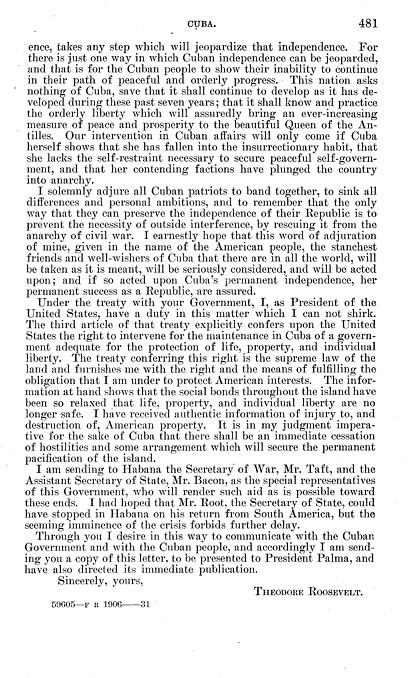
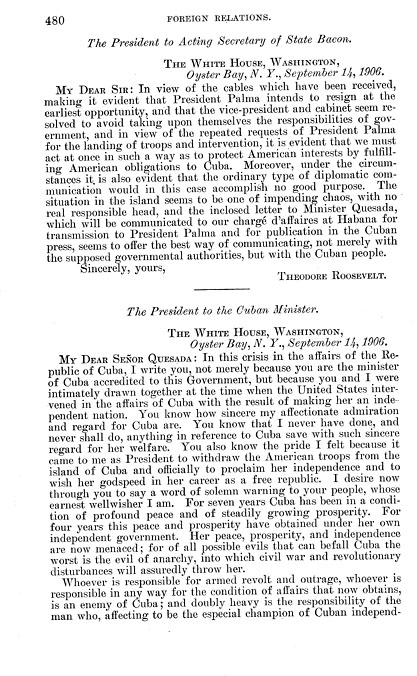
On September 14, 1906 President Theodore Roosevelt informed the Cuban foreign minister that he did not think they were capable of governing themselves and so invoking the Platt Amendment he was sending William Howard Taft to clean things up. It's quite an insulting message, as you would expect, though of course couched in terms of how much he wants the country to be independent.

"For there is just one way in which Cuban independence can be jeoparded, and that is for the Cuban people to show their inability to continue in their path of peaceful and orderly progress."

Replace "Cuba" with Chile, Guatemala, Panama you name it, and it's almost like a motto of U.S. foreign policy.

Here it is from FRUS:


I will be including this collection of digitized FRUS pages on Cuba for the "further sources" part of my U.S. and Latin American Relations 2nd edition textbook chapter that covers the first third of the 20th century. The University of Wisconsin has a lot of stuff digitized that is not on the State Department's own website.


Tuesday, July 8, 2014

Cuba and Menendez

From the Washington Post: so was the Cuban government involved in trying to concoct a story about Senator Robert Menendez? If it is the case, then it demonstrates the Cuban government is pretty unimaginative. The story about underage prostitutes fell apart almost immediately, as the women admitted they were coached and there was no evidence of anything. If the Cuban connection is true, then I assume they figured any sort of splash would possibly derail him. Instead, he won easily.

But if this story has legs and is true, then it will have been a Cuban blunder. There is a slow, painstaking process in the United States to rethink the fundamentals of our attitude toward Cuba. Unfortunately, doing something stupid like this can derail it, or at least postpone it.

Not for the first time, I wonder how much Raúl Castro really wants rapprochement. The status quo serves him well.

Tuesday, June 24, 2014

Odrisamer Despaigne and Cuban Players

VM Nate has an article in Padres Public about Odrisamer Despaigne, a Cuban defector who pitched for the Padres last night (and is an interesting addition to what otherwise has been a miserable team). He absolutely shined with seven shutout innings. It got me thinking about Cuban baseball in general.

The Cuban baseball market is a terrible mess. The players defect in ways that sometimes can be dangerous (at least it seems not to have been that way for Despaigne, who defected in Spain). Since the embargo prohibits teams from signing Cubans directly, they have to defect. Although the Cuban government has allowed for direct contracts as long as they are temporary (I am not sure how that is enforced but it means they have to play for the Cuban national team when needed) they can't just sign directly with U.S. teams.

So you get stories like Yasiel Puig's, which is so dark (and made me like him more). Meanwhile, fat contracts to a fortunate few entice more Cubans to do what they can to get here. Things have not changed much from when I reviewed the book The Duke of Havana almost eight years ago. If anything, human smuggling is even more violent.

Plus, what that book showed were the players that didn't cut the mustard. For every Yasiel Puig there are plenty of others struggling in obscurity, going into debt and facing all kinds of problems in their failed attempt to make the MLB.

One of the interesting insights from the book Raceball is that Mexico doesn't suffer this same fate because from an old agreement MLB teams must pay Mexican teams when they poach a player (Japan has a similar system dating back to 1967). That's really the only way you can stop the human smuggling. This solution is currently impossible for Cuba because the embargo prohibits it--in any case the money would end up directly in the government's hands since unlike elsewhere it owns all teams. I also can't see why MLB would agree to such an arrangement again. The Japan and Mexico deals were struck long before players made tons of money.

I wish MLB would make a formal statement on Cuban defectors. When pushed Bud Selig defers:

"You’re getting into an international political situation," he said. "Commissioners have a lot of power but they don’t have an international power. It [Yasiel Puig's story] was a tough story to read." 
Selig said that there have been internal discussions about trying to do something on the issue but "it gets into a level that is really beyond us."

Well, yes, only Congress can change the law. But he could say that this is a tragedy unfolding with lots of suffering involved and that the players would be much better off with a negotiated solution. But he won't say much beyond platitudes and neither will the player's union. You can be sure the owners won't. Because this is immensely profitable. The losers don't matter to MLB but the money and the exciting stars do.

Tuesday, June 17, 2014

FIU Poll on Cuban Americans

The Cuban Research Institute at FIU released its annual poll on Cuban-American views of Cuba policy. The results are not particularly surprising. Young people oppose the embargo more than older, a majority oppose it; a strong majority favors re-establishing diplomatic relations and lifting travel restrictions; a large majority say the embargo isn't working very well.

It bears repeating that demography matters a lot for understanding these views. Younger Cuban Americans just don't support the old-style punitive policies.


That's a lot of downward movement in the past 23 years and we can reasonably expect it to continue slowly sloping. There is tremendous lag, though, between those changing views and the response from hardliners in the House and Senate, who are out of step with the majority but still receive a lot of money from the older population. The poll suggests that someday, and maybe not even that far into the future, we'll see the election of a Florida politician (maybe even a Cuban American) who runs with engagement as part of his or her platform.

Tuesday, June 10, 2014

Targeted Cuba Sanctions

Ricardo Herrero, the Executive Director of Cuba Now (or is it #CubaNow with automatic hashtags?) criticizes the embargo in the Huffington Post. He does a good job in pointing out its numerous problems and how it is counterproductive to U.S. interests and stated U.S. policy goals of helping the Cuban people. One sentence, though, gave me pause:


Any sanctions on Cuba should be targeted toward those individuals directly involved in human rights violations on the Island.


This is all the rage these days for Latin America (Venezuela is the high profile case right now) though it's not a new concept globally. I have yet to see any analysis demonstrating that targeted sanctions are effective. In fact, most of you read suggests the opposite.

Instead, at least in Latin America they're barely even intended to work. I am not sure whether advocates of Venezuela sanctions really believe they're going to have an impact (though maybe they do) but they need to be seen as doing something. In the case of Cuba, these proposals are tossed out there as a bone to appease the more rabid anti-Castro lawmakers that something will still be done. We're not getting rid of sanctions, just doing a little nip and tuck.

Having said that, I would much prefer small failed sanctions than huge failed sanctions, which is what we've got now.

Wednesday, June 4, 2014

Fidel Is Out of the Loop

CNN reported that Fidel Castro wrote publicly that he had no idea that Eugenio George, a famous volleyball coach, had died until he read about it in the newspaper. Here is the original message Fidel wrote in Granma. That was prompted by people asking him why he hadn't sent flowers.

That no one took the initiative to tell him is not particularly noteworthy. What's more interesting is that he chose to make a public statement about it, in large part to avoid losing face. But the fact that the founder of the revolution was reduced to whining publicly is, as far as I know, novel.

h/t Joenie Hilfer on Twitter

Tuesday, May 27, 2014

Kennedy, Congress, and Cuba

Asa McKercher, "Steamed Up: Domestic Politics, Congress, and Cuba, 1959-1963." Diplomatic History 38, 3 (2014): 599-627.

Abstract:
Studies examining the initial response of the United States to Cuba’s revolution largely ignore the role of Congress, an oversight reflecting both a scholarly trend emphasizing the actions of the presidency in regards to American foreign policy making and the separation of powers in the U.S. constitution. Redressing the balance, this article examines how members of Congress reacted to the course of U.S.-Cuban relations throughout the crisis years of 1959–1963. Illuminating Cuba’s place in domestic debates about foreign affairs it also looks at the politics surrounding the American response to the Cuban revolution. Lawmakers quickly emerged at the forefront of those calling for a strong stance toward Cuba. In turn, congressional pressure to confront Fidel Castro both helped and hindered presidents Dwight Eisenhower and John Kennedy. For Kennedy, in particular, domestic politics and actions by Congress were major concerns that tempered his actions in dealing with the Cuban revolution.

The key argument is that studies of early U.S. policy toward the Cuban revolution focus on the executive, so this is opening that up. The ultimate conclusion is not too surprising.

Thus, the executive found it necessary to look tough in standing up to Castro. However, as President Kennedy’s comments to the press in September 1962 indicate, he was focused not only on avoiding the appearance of appeasing Castro but on resisting congressional pressure to take precipitate action against Cuba.

I enjoy these sorts of studies because even as a political scientist I like diving into archival records. We tend to get stuck on the idea that presidents intervene without providing the context for it. With Kennedy we know very well from the Cuban Missile Crisis that he was not anxious to get involved, so it makes good sense to look more closely at the congressional side.

If you're wondering, the conclusion here is that Congress was committed to sanctioning Cuba as much as possible, a pressure Kennedy had a difficult time resisting. The debate sounds eerily similar to the one going on now with Venezuela, though the stakes of course are far lower so it remains largely peripheral to the public eye.

It would benefit a bit, though, from more attention to work by political scientists. In my graduate U.S.-Latin American Relations course I use Michael Grow's U.S. Presidents and Latin American Interventions, where he looks at domestic opinion--generally driven by congressional leaders--as a main explanatory variable for understanding presidents' decisions to intervene.

Wednesday, May 21, 2014

Yoani Sánchez's Newspaper

Yoani Sánchez started an online newspaper in Cuba called 14ymedio.com. Apparently so far it has not been blocked by the Cuban government.

What I find particularly interesting about it is that it is not opposition per se. Think Venezuela, with all the insults and slurs. Instead, it is a collection of different types of stories that transcend politics. Instead, you get this indirect digs, quick indications of a state that has pretty ossified. Take this story about baseball versus football in Cuba:

La mayor pesadilla del fútbol cubano estriba en tener al enemigo dentro y disfrutando, además, de una estrecha complicidad con el Instituto Nacional de Deportes y Recreación (INDER). Esta entidad se muestra preocupada hasta el desvelo por salvaguardar la prevalencia del béisbol en tanto "deporte nacional", como si las preferencias deportivas fueran un tema de seguridad nacional o una cuestión de Estado.

This isn't about politics, but it reveals how far the state has extended its control to impose even particular sports on the country. Everything down to the most trivial is somehow a matter of national security, and this publication pokes fun at it. This is more likely to generate sympathy than a sledgehammer strategy, and of course is less likely to be censored. It's calling for a rethinking of what has been taken for granted, not for regime change.

We know there are clear limits but not necessarily where they are. Yoani Sánchez has been masterful at becoming known globally and it is therefore harder for the government to crack down on her. But if she pushes too far, they will, but right now we're in uncharted waters.

Update: The Cuban government blocked access to it after I posted. Seems times haven't changed at all and the waters are quite well charted!

Tuesday, May 20, 2014

Using Cuba in Venezuela Talks

Juan Gabriel Tokatlian argues that the United States and Cuba could work together to stabilize Venezuela.


Maybe, and just for a brief window of opportunity, there is some room for a concerted, quite diplomacy between the United States and Cuba regarding Venezuela. UNASUR, the United States and Cuba all have certain legitimate national interests at stake there and not many of them are incompatible. A combination of incentives and restraints, patience and demands, political carrots and diplomatic sticks can be designed over the medium and long term. There is not a quick fix, nor a magic bullet when dealing with the Venezuelan crisis. The core issue at this moment should be respect for human rights, the establishment of a realistic political dialogue, and the commitment of all domestic parties to democratic strengthening and against authoritarianism. [emphasis mine]

I appreciate the creativity--which the Venezuela crisis could use--but something puzzles me. Cuba does not respect human rights, has no political dialogue, and is opposed to democratization. So how can it help in promoting those things in Venezuela?

Further, economically the Cuban government is desperately dependent upon the continuation of a Chavista government so it really cannot act as a neutral arbiter in any case. Its goal will be to neutralize the opposition and prop up the government.

Monday, May 19, 2014

Letter to Obama on Cuba

A high profile group has sent President Obama an open letter (text here) calling for liberalization of Cuba policy. It focuses on removing travel restrictions, financial restrictions, and high level dialogue in areas of mutual interest, all of which can be achieved by executive order. In short, it advocates common sense. It does not call for ending the embargo, but baby steps are fine for now.

But timing matters and this window of opportunity may not remain open indefinitely. At the same time, the U.S. is finding itself increasingly isolated internationally in its Cuba policy. In the current political climate little can be done legislatively, but the Obama Administration has an unprecedented opportunity to usher in significant progress using its executive authority at a time when public opinion on Cuba policy has shifted toward greater engagement with the Cuban people while continuing to pressure the Cuban government on human rights.

The signatories range from business, the (retired) military, the Democratic Party, business, and think tanks, but John Negroponte also signed it, and he is not what you'd call liberal.

This is about chipping away. The general public has supported opening up for years, though few see it as a pressing issue. Meanwhile, even Republican governors have traveled to Cuba to engage in cash-based trade. So the public opinion piece is there and so is the economic piece. What remains is the ideological piece, which is centered in Florida and absolutely set on blocking any and all of these reforms.

Slowly adding people like Negroponte to the mix can have an ideological impact because he enjoys tremendous respect within the conservative ranks, basically for the same reasons he enjoys the exact opposite within liberal ranks (including, for example, his support for the Contras and looking the other way at serious abuses in Honduras). If any conservatives are on the fence, he is someone they can publicly refer to.

Tuesday, May 13, 2014

Cuban Response to Future U.S. Actions

José Ramón Ponce Solozábal (a psychologist with what looks like a fascinating background, including working in Cuban counterintelligence) just published an article in Military Review on the possibility of a "Cuban spring," which refers to the article I published there in 2012 on the same topic with Erin Fiorey, who at the time was a Latin American Studies graduate student here. Ours was very policy oriented whereas his is more political theory.

Sin embargo, la creciente oposición y la lentitud del avance económico, auguran la inexorable
participación en algún momento, por razones geográficas e históricas de los Estados Unidos
de Norteamérica, como acertadamente apuntan Gregory Weeks y Erin Fiorey. 
No obstante, el artículo de dichos autores, si bien analiza brillantemente la situación cubana,
enfoca mecánicamente la posible actitud de la Cuba futura en lo que respecta a la participación
estadounidense. La secuencia de hechos históricos en la relación Cuba-Estados Unidos narrados, conduce a inferencias como cálculo matemático,pero la constatación práctica, in situ, del sentir de esa población en la actualidad, hace pensar en un salto muy significativo, lo cual pone en duda que se produzca una postura no conveniente para Estados Unidos en el momento de la transición a la democracia; aunque aciertan en considerar que esa relación puede caminar por el “filo de la navaja”

The first part is a nice compliment, and then he makes an interesting (and certainly debatable) point that we're a bit too mechanistic in our assumptions about how Cubans will respond to some eventual U.S. action in Cuba. Especially based on the rest of the article, what I take this to mean is that he believes Cubans may well be more sympathetic to the United States once they have a choice and are no longer so tightly controlled.

My hunch is that the United States will be met with considerable skepticism, but I do have to admit that such an assessment is based on certain assumptions (the punishment of the embargo, historical animosity, among others) that could turn out to be wrong. I would argue that at the very least we should maintain those assumption until the opposite is very clearly evident. I can envision just blundering into a post-Castro context, intent on showing Cubans what they should do next.

Friday, May 2, 2014

Cuba as State Sponsor of Terrorism

Here is the entire justification of the State Department's justification of having Cuba listed as a state sponsor of terrorism.

             Cuba was designated as a State Sponsor of Terrorism in 1982.
Cuba has long provided safe haven to members of Basque Fatherland and Liberty (ETA) and the Revolutionary Armed Forces of Colombia (FARC).  Reports continued to indicate that Cuba’s ties to ETA have become more distant, and that about eight of the two dozen ETA members in Cuba were relocated with the cooperation of the Spanish government.  Throughout 2013, the Government of Cuba supported and hosted negotiations between the FARC and the Government of Colombia aimed at brokering a peace agreement between the two.  The Government of Cuba has facilitated the travel of FARC representatives to Cuba to participate in these negotiations, in coordination with representatives of the Governments of Colombia, Venezuela, and Norway, as well as the Red Cross.  
There was no indication that the Cuban government provided weapons or paramilitary training to terrorist groups.

The Cuban government continued to harbor fugitives wanted in the United States.  The Cuban government also provided support such as housing, food ration books, and medical care for these individuals.

In other words, the justification for keeping them on the list is that they are not actually sponsoring any terrorism at all. In fact, they are working with other countries to end the Colombian civil war.

When asked about this very point, the State Department's spokesperson could only say that the State Department's own report showing they were not sponsoring terrorism was not part of the process for removing them from the list. There is in fact no process at all!

QUESTION: ETA and the FARC as well. But also – but given the fact that these two groups, the threat from them is diminishing, I mean, there are peace talks going on with the FARC at the moment. Whether they’re successful I don’t know, but – but it also states in the report there was no indication that the Cuban Government provided weapons or paramilitary training to any terrorist group.
So my question is: How much longer are you going to keep Cuba on the list of state sponsors of terrorism?
MS. HARF: Well, it’s a good question that I know comes up a lot. The State Department has no current plans to remove Cuba from the State Sponsors of Terrorism list. As you may or may not know, there’s not a routine process by which you re-evaluate the state sponsors like there are, for example, with our terrorist designations for terrorist groups. So you can’t get into the process any more behind the scenes, but at this point, again, no plans to remove them.
QUESTION: But it would seem if they’re not supporting terrorist groups with weapons or training, and they’re retained because of the haven that they reportedly give to ETA and FARC, it doesn’t really make much sense they’re still on the list.
MS. HARF: Again, I don’t have any more details in terms of the reasoning that goes into that. Again, there’s no regular process for re-evaluating this. If there’s a policy reason to do so based on the conditions on the ground, I know folks will. But at this point, no plans to remove them from the list.

This is nonsensical but that is the hallmark of U.S. policy toward Cuba. Remember that North Korea was actually taken off the list in 2008. Try to compare the two and it doesn't work out too well.

Thursday, April 17, 2014

Fertility in Cuba

I took this directly from Patrick Oppmann, a CNN reporter in Havana, so I can't claim originality but this is a great juxtaposition. On the one hand, the Cuban government is concerned about the low birth rate in the country:

According to experts, the decreasing fertility trend in Cuba, low mortality rate, and negative results from external migrations (-4.2 per 1,000 inhabitants according to the 2012 Statistical Yearbook) has caused a low population growth in Cuba for many years, and is the lowest one in Latin America when compared at the regional level. 

Hence, the Ministry of Public Health has already implemented certain policies to encourage fertility and ensure safe gestation, providing attention to women before, during and after pregnancy, as well as encouraging reproduction among women from 30 to 39 years old, and carrying out other actions to increase medical assistance for infertile couples.

On the other, condoms are suddenly and mysteriously in short supply.

The Communist Party’s newspaper in the province of Villa Clara, Vanguardia, tried to explain the reasons for the condom shortage in an April 3 report, and all but drowned in a sea of unanswered questions and typically complex acronyms for government agencies.

Read more here: http://www.miamiherald.com/2014/04/16/4063871/condom-shortage-hits-cuba.html#storylink=cpy

The Communist Party’s newspaper in the province of Villa Clara, Vanguardia, tried to explain the reasons for the condom shortage in an April 3 report, and all but drowned in a sea of unanswered questions and typically complex acronyms for government agencies.
Read more here: http://www.miamiherald.com/2014/04/16/4063871/condom-shortage-hits-cuba.html#storylink=cpy
Coincidence?

Here are some ways other countries have dealt with low fertility. Do it for Denmark!