According to reports, the Venezuelan government has arrested Miami Herald reporter Jim Wyss and put him in prison.
Some initial thoughts:
1. It is hard to imagine Venezuelan law enforcement arresting a prominent reporter, especially from the U.S., without clear prior authorization. Not impossible, but hard to imagine. The fact that he was transferred to military intelligence is a good indication.
2. If #1 is true, then Nicolás Maduro is trying to pick a fight. I can see logic behind that, as he talks constantly about an economic war from the U.S. without any evidence, but if he incurs sanctions (a la Cuba) then he has something tangible to point to for blame.
3. If #1 is true, then Maduro is even more desperate than I thought, though making Christmas come early is a pretty good indicator.
4. If #1 is NOT true, then Maduro has a problem. His heated rhetoric probably backs into a corner so that he needs to show strength, maybe by expelling Wyss from the country? Though I suppose he could show his magnanimity by letting him stay.
5. You can't spin putting reporters in prison.
Update: he was just released. I realize I did not add another option, which is pretend it never happened. But let's wait and see the Venezuelan government response. #1 may well be totally wrong.
Update 2: Here is his story. It makes his arrest and interrogation sound like local thuggery, and as far as I can see neither the government nor pro-government media has mentioned it at all.
Saturday, November 9, 2013

Thursday, November 7, 2013
Latinos and Democratic Mayors in Charlotte
Above the fold on the front page of today's Charlotte Observer (yes, I actually get a paper paper) was the headline "Can Charlotte Republicans Regain Mayor's Office" (accompanied by a quote by my political science colleague Eric Heberlig). I used it in my Politics of Latino Immigration class today because it fit so well with our ongoing discussions of political demography. The article's point was that demographics are favoring the Democratic Party in Charlotte. It has this very nice map comparison between the 2007 and 2013 mayoral elections.

You can see how the red is concentrated heavily in south Charlotte, and is shrinking. What the article unfortunately doesn't do, however, is integrate that analysis with the growth of the Latino population, which is a pretty glaring omission.
In work I've done with my dad, we got data on births in Mecklenburg County, then mapped them. Here is what you get:

What you can see is that the Latino population is dispersed across Charlotte, though less so in south Charlotte (which is more wealthy and white). If you combine it with the mayoral map, you end up with a city and county that will become bluer and bluer because of course Latinos support the Democratic Party by a very large margin. The children being born will not be voters for at least 18 years, but our map can also be viewed as a proxy for Latino families. Some are already citizens and non-citizens will slowly naturalize, faster if immigration reform with some sort of amnesty with path of citizenship is passed (which, naturally, is one reason many Republicans oppose it).
Thus, in Charlotte it will be really, really hard for Republicans to win mayoral elections. And by the way, in the future it may well get more difficult to win County Commissioner seats as well, if you look at the data for Hispanic births by county commission district.

As I keep repeating to my class, it doesn't matter if you like or dislike this. It's just the way things are, and demographic shifts are going to have major political impacts.

You can see how the red is concentrated heavily in south Charlotte, and is shrinking. What the article unfortunately doesn't do, however, is integrate that analysis with the growth of the Latino population, which is a pretty glaring omission.
In work I've done with my dad, we got data on births in Mecklenburg County, then mapped them. Here is what you get:
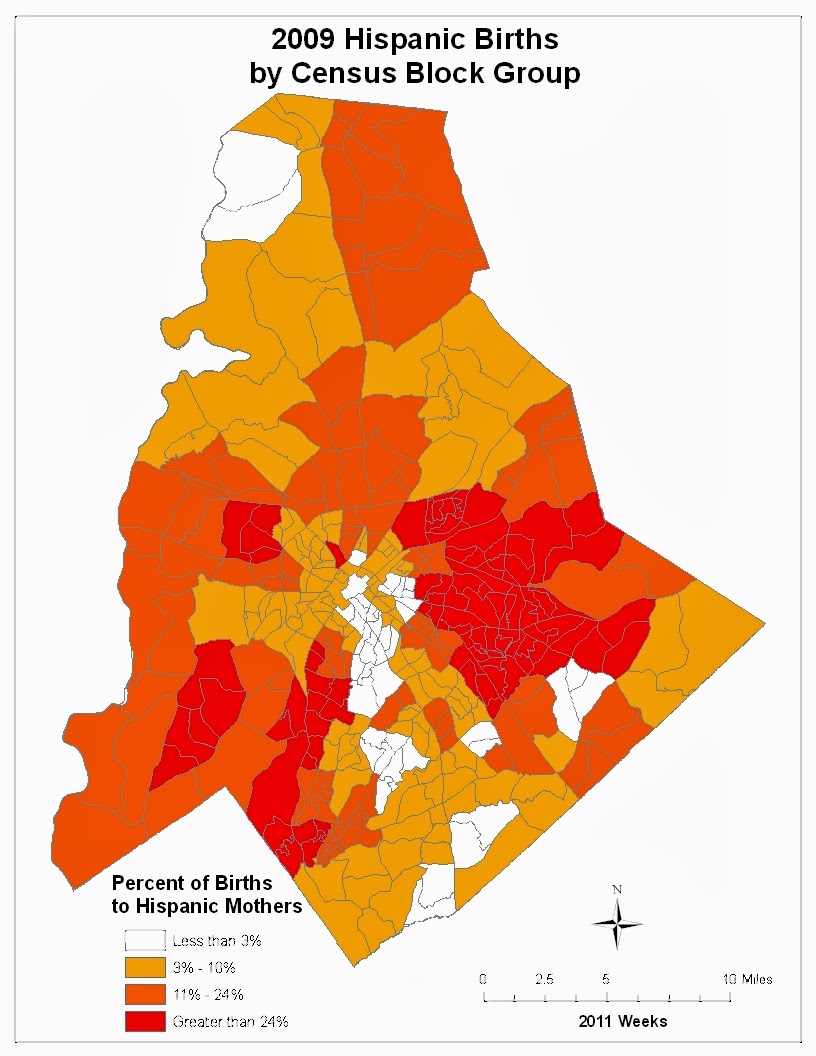
What you can see is that the Latino population is dispersed across Charlotte, though less so in south Charlotte (which is more wealthy and white). If you combine it with the mayoral map, you end up with a city and county that will become bluer and bluer because of course Latinos support the Democratic Party by a very large margin. The children being born will not be voters for at least 18 years, but our map can also be viewed as a proxy for Latino families. Some are already citizens and non-citizens will slowly naturalize, faster if immigration reform with some sort of amnesty with path of citizenship is passed (which, naturally, is one reason many Republicans oppose it).
Thus, in Charlotte it will be really, really hard for Republicans to win mayoral elections. And by the way, in the future it may well get more difficult to win County Commissioner seats as well, if you look at the data for Hispanic births by county commission district.

As I keep repeating to my class, it doesn't matter if you like or dislike this. It's just the way things are, and demographic shifts are going to have major political impacts.
Wednesday, November 6, 2013
Christmas Comes Early in Venezuela
How had I missed this? A student pointed out to me that Nicolás Maduro has declared that Christmas will come early in Venezuela. I was immediately skeptical but there it is in the official state news agency. No doubt this will mean that Santa Claus will visit many Venezuelans prior to the December 8 elections and shower them with happiness in the name of Comandante Eterno himself.
It is going to celebrated all over the country, with so much felicidad.
Man, this is seriously weird.
It is going to celebrated all over the country, with so much felicidad.
Más temprano, el ministro para la Cultura, Fidel Barbarito, informó al país acerca de las actividades organizadas para dar inicio de la Navidad en el país con el máximo exponente cultural y el disfrute en los espacios públicos recuperados.
Durante entrevista en el programa Toda Venezuela, transmitido por Venezolana de Televisión, Barbarito informó que desde este viernes se realizarán en Caracas y en todo el país actividades para celebrar la llegada de la temporada navideña.
Man, this is seriously weird.
Tuesday, November 5, 2013
Michelle Bachelet Op-Ed
My co-author Silvia Borzutzky and I have an op-ed in the Miami Herald about the return of Michelle Bachelet, really building on the co-edited volume we published in 2010. The upshot is that she is making a lot of promises without much chance of fulfilling them, following a pattern from her first term. I think disillusionment is much more likely than a populist shift that some alarmists are bringing up.
Monday, November 4, 2013
How Political Science Professors Shouldn't Act
From Inside Higher Ed, a political science professor in Canada makes fun of a student:
Somehow "being a jerk" gets translated to the more neutral "speaking your mind." You have a student who is trying to articulate something that involves publicly admitting their own ignorance, and your response is to humiliate and shame them? Of all people, political scientists should know that the political system is complicated, and what we try to do in our classes is explain it.
To be fair, he was contrite. But:
I don't disagree, but what's missing is that in fact helping people do this is our job as political scientists and the takeaway should be that we should find better ways of doing it rather than just bemoaning ignorance.
Shaun Narine, associate professor of political science, was at a campus lecture by a journalist who asked the students in attendance (from political science and journalism programs) why young people don't vote. One student said that it was because students don't understand the political system, and find it complicated.
Narine quickly interjected: "Read a book, for God's sake."
Somehow "being a jerk" gets translated to the more neutral "speaking your mind." You have a student who is trying to articulate something that involves publicly admitting their own ignorance, and your response is to humiliate and shame them? Of all people, political scientists should know that the political system is complicated, and what we try to do in our classes is explain it.
To be fair, he was contrite. But:
But as to the point that she should read a book, and become more informed? He said he stands behind that idea. "Very much so. What I did was wrong for a variety of reasons. On the other hand though, I think the reason for my frustration was valid. I don’t want to justify myself. I genuinely felt like an ass. But I’m not going to pretend that I don’t feel strongly that our students, and Canadians in general, need to know enough about their political system that they can participate in it in a meaningful way," he said.
I don't disagree, but what's missing is that in fact helping people do this is our job as political scientists and the takeaway should be that we should find better ways of doing it rather than just bemoaning ignorance.
Sunday, November 3, 2013
Economic Growth & Suicide in Chile
The Chilean economy has received an enormous amount of attention, maybe more so than any other Latin American country. We know a lot about the economic growth and social precarity that has accompanied it. The latter helps us get a grip on why there is so much protest.
What I've never considered, however, is the effect on suicide. From CIPER Chile, here is a really troubling graph from a really troubling article. It shows the change of suicide rate from 1995-2009 in OECD countries.

Chilean economic growth has involved "flexible" labor and a sense of vulnerability along with persistent (and for so many people, seemingly intractable, inequality). The rate of adolescent suicide has skyrocketed.
What the author concludes is that social supports have lagged far behind economic growth. As more young people hear about how great things ought to be, yet fall behind, they need ever stronger safety nets and social support, which at the moment are not there.
What I've never considered, however, is the effect on suicide. From CIPER Chile, here is a really troubling graph from a really troubling article. It shows the change of suicide rate from 1995-2009 in OECD countries.

Chilean economic growth has involved "flexible" labor and a sense of vulnerability along with persistent (and for so many people, seemingly intractable, inequality). The rate of adolescent suicide has skyrocketed.
What the author concludes is that social supports have lagged far behind economic growth. As more young people hear about how great things ought to be, yet fall behind, they need ever stronger safety nets and social support, which at the moment are not there.
Friday, November 1, 2013
Guatemala-Chiapas Circular Migration
Here is a really interesting article (in Spanish) by Jéssica Nájera Aguirre from the Colegio de México on circular migration between Guatemala and Chiapas, sometimes on a daily basis, always with the intention of maintaining residence in Guatemala. We're talking 300,000-400,000 people a year.
What I don't get, however, is how there is so much demand for labor when--at least on the surface--we might expect plenty of Mexican supply already to exist.

Given the high levels of poverty in Chiapas, is there not resentment on the part of Mexicans toward Guatemalans who cross the border and sell goods (which is the second largest source of employment)? Further, why is it that agricultural demand is not being met with local supply?
I don't know the answer to those questions, but what we see is a border region that is now transnational to a much greater degree than in the past. I imagine the reasons for this can be in found to a significant degree in Guatemala. The article does not address the issue directly, but clearly Guatemalans cross the border because opportunities at home are too scarce, and in recent years--more or less the last decade--the sense of insecurity has increased. And as we know from the U.S. side, once this type of migratory pattern starts, it does not stop.
What I don't get, however, is how there is so much demand for labor when--at least on the surface--we might expect plenty of Mexican supply already to exist.

Given the high levels of poverty in Chiapas, is there not resentment on the part of Mexicans toward Guatemalans who cross the border and sell goods (which is the second largest source of employment)? Further, why is it that agricultural demand is not being met with local supply?
I don't know the answer to those questions, but what we see is a border region that is now transnational to a much greater degree than in the past. I imagine the reasons for this can be in found to a significant degree in Guatemala. The article does not address the issue directly, but clearly Guatemalans cross the border because opportunities at home are too scarce, and in recent years--more or less the last decade--the sense of insecurity has increased. And as we know from the U.S. side, once this type of migratory pattern starts, it does not stop.
Subscribe to:
Posts (Atom)