Reporters from News Channel 14 just came to my office to ask some questions about the Latino vote. Of course, that prompted me to try and get my facts straight.
Kay Hagan has been polling well recently (up 3-6% or so) against Thom Tillis, with the added factor that Libertarian Sean Haugh is likely drawing more Tillis-leaning voters than Hagan-leaning (in May 2014 he polled at 5%).
As of today, Latinos constitute 1.9% of registered voters in North Carolina (and currently only about a quarter of Latinos in NC are eligible to vote at all). Latinos vote in lower numbers than other racial/ethnic groups, and this is a midterm election to boot. Further, 37% of Latino registered voters are 18-29 years of age, so less likely to vote in the first place.
However, in a close race--as this one is--any push is important. The Latin American Coalition is hoping to register 7,500 new voters for this election. That's no easy task (for context, 123,763 Latinos are registered to vote right now) but if they can do it they may well make a difference.
Showing posts with label Latinos. Show all posts
Showing posts with label Latinos. Show all posts
Wednesday, September 17, 2014

Friday, January 31, 2014
House Republicans on Immigration
House Republicans released a one-page statement on immigration reform, which outlines what their version would look like. As you would expect, its importance is more symbolic than substantive. Most prominently, its existence serves as open acknowledgment that it is quite impossible to deport or detain the millions of people living in the country illegally, and therefore a humane solution is required. It is akin to admitting the sky is blue after insisting for years that it was green. It is also equivalent to holding up a sign that says, "Dear Latinos, we don't hate you as much as it seems."
So that part is at least a small step forward, but you have wonder how this mouthful will be translated into concrete policy:
What does it mean to prove the ability to support yourself? Sadly, these days a minimum wage does not allow a family to live without food stamps or other support. How will people come up with the cash for "significant" fines if they're also going to support themselves? Further, I've written before about enforcement triggers--Obama has cracked down harder on undocumented immigrants than any president in the history of the United States, so it's unclear how measurement will work.
The "no special path to citizenship" doesn't mean no citizenship, but rather just following the same cumbersome and inefficient system everyone else suffers through. My hunch is that this will not be a major stumbling block given other concessions, but I could be wrong. I'd need to see more about whether it's accurate to estimate that half of current undocumented immigrants wouldn't ever be eligible for citizenship.
So that part is at least a small step forward, but you have wonder how this mouthful will be translated into concrete policy:
Our national and economic security depend on requiring people who are living and working here illegally to come forward and get right with the law. There will be no special path to citizenship for individuals who broke our nation's immigration laws – that would be unfair to those immigrants who have played by the rules and harmful to promoting the rule of law. Rather, these persons could live legally and without fear in the U.S., but only if they were willing to admit their culpability, pass rigorous background checks, pay significant fines and back taxes, develop proficiency in English and American civics, and be able to support themselves and their families (without access to public benefits). Criminal aliens, gang members, and sex offenders and those who do not meet the above requirements will not be eligible for this program. Finally, none of this can happen before specific enforcement triggers have been implemented to fulfill our promise to the American people that from here on, our immigration laws will indeed be enforced.
What does it mean to prove the ability to support yourself? Sadly, these days a minimum wage does not allow a family to live without food stamps or other support. How will people come up with the cash for "significant" fines if they're also going to support themselves? Further, I've written before about enforcement triggers--Obama has cracked down harder on undocumented immigrants than any president in the history of the United States, so it's unclear how measurement will work.
The "no special path to citizenship" doesn't mean no citizenship, but rather just following the same cumbersome and inefficient system everyone else suffers through. My hunch is that this will not be a major stumbling block given other concessions, but I could be wrong. I'd need to see more about whether it's accurate to estimate that half of current undocumented immigrants wouldn't ever be eligible for citizenship.
Friday, December 20, 2013
Richard Helms' Six Mile Creek
Richard Helms' Six Mile Creek is a murder mystery with a bit of social commentary attached to it. The setting is a small North Carolina town, not too far away from a larger city like Charlotte. A high school girl, who is Latina, is found murdered. Police Chief Judd Wheeler investigates.
It's not filled with Deep Thoughts, but the overall theme is about preconceptions and deep seated views. Everyone assumes there is a race war brewing, when there is not. Everyone assumes drugs have not reached the town, when they have. Everyone holds high school football players on a pedestal, when they don't deserve it. The stereotype that turns out to be justified (in the novel, anyway) is that rich white men who control small towns are largely jerks.
Chief Wheeler solves the crime, of course, as well as a few others that pop up along with the way. What he finds is high school replicating adulthood. The same obsession with money and status. Even ethnicity is subsumed under that, Anglo-Latino tensions are less about "difference" per se and more about encroachment on women or turf.
What is oddly missing is a single African American character. The town is Anglo or Latino.
As a solid mystery, I recommend it.
Wednesday, November 20, 2013
JFK and Latinos
There have been some interesting stories about JFK and Latinos. Jacqueline Kennedy had famously spoken in Spanish, and he ultimately won 85% of the Mexican-American vote. There were "Viva Kennedy" clubs to get out the vote. Mostly, it is a story of tremendous hope and little accomplishment:
And:
But his speech is now part of historical lore, taken as a sign that he was committed to helping the Latino population, even though there were no real accomplishments behind the words.
The symbolic gesture, though, was enough to spark hope. Even the Cesar Chávez Foundation credits him:
Others, though, see that influence stemming more from failure to get attention from the White House, both with Kennedy and afterward:
Mythology is an amazing thing.
For many Latinos President Kennedy’s first term was disappointing. A number of promises that Latinos felt Kennedy owed them had not materialized. The President had also fallen short on appointing Hispanics to high-level government positions.
And:
The night before his assassination, JFK addressed the League of United Latin American Citizens in Houston.
But as many scholars have written since, Kennedy did not deliver on the hope he inspired among Latinos. African American civil rights heroes also had been frustrated with Kennedy, despite being enamored of him personally.
But his speech is now part of historical lore, taken as a sign that he was committed to helping the Latino population, even though there were no real accomplishments behind the words.
But during Kennedy's first months in office, Latino leaders expressed dismay that the president had failed to appoint Hispanics in his administration. Chavez even openly criticized Kennedy for his lack of appointments; other leaders embarked on a letter-writing campaign over the slow movement on civil rights.
The symbolic gesture, though, was enough to spark hope. Even the Cesar Chávez Foundation credits him:
Many credit the current growing influence of the Latino vote as the result of President Kennedy’s pioneering efforts.
Others, though, see that influence stemming more from failure to get attention from the White House, both with Kennedy and afterward:
The failure of the American political system to adequately deliver on those concerns opened up the barrios to a larger civil rights effort in the 1960s. This new generation fought for many of the same rights. Their goal was not Camelot, but Aztlán, the legendary home of the Aztecs and Chicano activists' rallying cry - a place where "Viva Clubs" were not a prerequisite for change.
Mythology is an amazing thing.
Tuesday, November 19, 2013
North Carolina, Immigration & Redistricting
Rob Christensen at the Raleigh News & Observer has an interesting article on the GOP, immigration reform and North Carolina. It shows the shifts in support for reform by different groups.
Just one quibble. I've now seen this sort of thing argued more than once:
I think this is misleading and perhaps inaccurate. The South has traditionally seen a binary racial divide, with African Americans voting overwhelmingly in favor of the Democratic Party. Redistricting, then, has often involved drawing lines around population concentrations of African Americans. For example, check out Rep. Mel Watt's district:

But as I've argued elsewhere, Latinos in North Carolina have not necessarily concentrated in those same areas. In fact, they're dispersed geographically. In many cases they are living in the same districts as whites but are not eligible to vote. In my opinion, redistricting right now is irrelevant when you're talking about less than 2% of the total electorate (which is the case with Latinos in North Carolina right now).
However, redistricting is extremely important in the long term because areas considered safely Republican now won't be as a result of Latinos gaining the right to vote, either by becoming 18 or naturalizing. In that regard, check out my own district:

I live in a tiny tip of this district and it sprawls all over, but avoiding the city center, where there are African Americans, and seeking out whiter suburbs. Therefore it is solidly conservative. Now, let's compare my district to Latino births in 2009 from the research I've done with my dad (and see this recent blog post):

Births mean citizens, which mean future voters. District 9 goes outside Mecklenburg County so the fit is not perfect, but there are more and more Latinos being born in the district because they live in the suburbs. Here is a key point--district 9 avoids the city center, but there are few Latinos there anyway. Redistricting has never been aimed at them.
So we come to my own hypothesis, which is that redistricting works in the short term and backfires in the long term for Republicans.
Just one quibble. I've now seen this sort of thing argued more than once:
Because of redistricting, most Republican House members represent districts that have few Hispanic voters. But they do have to worry about their right flank in GOP primaries.
I think this is misleading and perhaps inaccurate. The South has traditionally seen a binary racial divide, with African Americans voting overwhelmingly in favor of the Democratic Party. Redistricting, then, has often involved drawing lines around population concentrations of African Americans. For example, check out Rep. Mel Watt's district:

But as I've argued elsewhere, Latinos in North Carolina have not necessarily concentrated in those same areas. In fact, they're dispersed geographically. In many cases they are living in the same districts as whites but are not eligible to vote. In my opinion, redistricting right now is irrelevant when you're talking about less than 2% of the total electorate (which is the case with Latinos in North Carolina right now).
However, redistricting is extremely important in the long term because areas considered safely Republican now won't be as a result of Latinos gaining the right to vote, either by becoming 18 or naturalizing. In that regard, check out my own district:

I live in a tiny tip of this district and it sprawls all over, but avoiding the city center, where there are African Americans, and seeking out whiter suburbs. Therefore it is solidly conservative. Now, let's compare my district to Latino births in 2009 from the research I've done with my dad (and see this recent blog post):
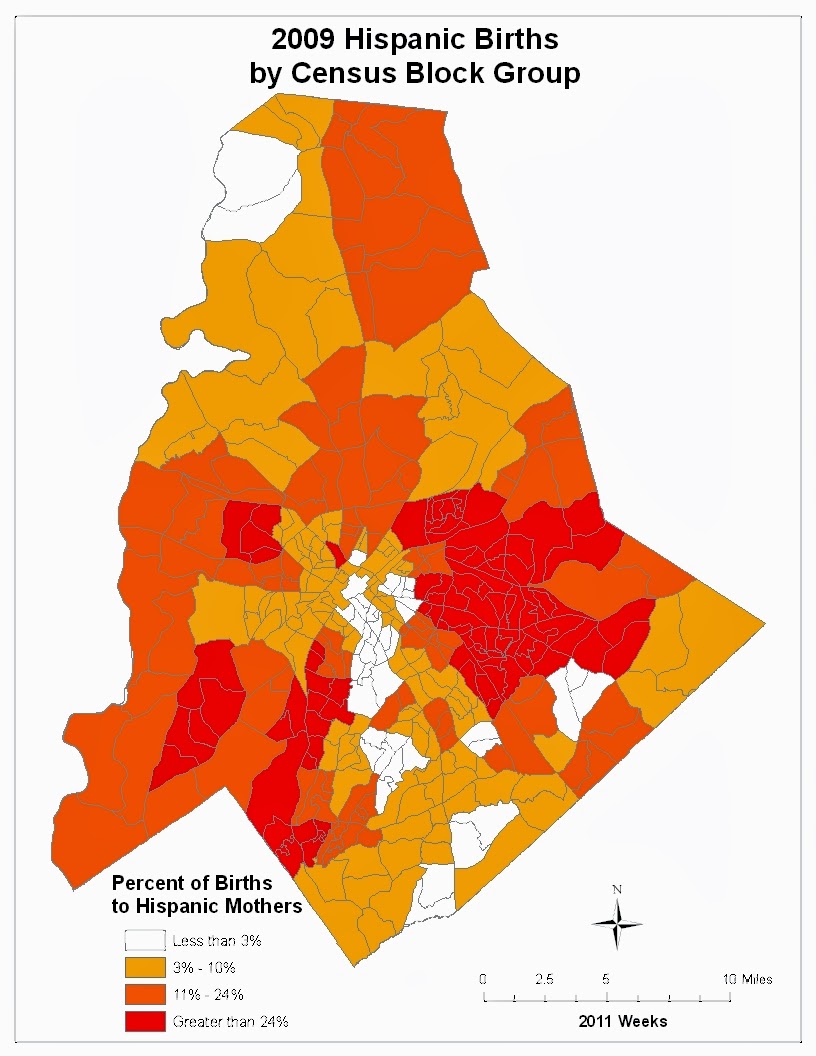
Births mean citizens, which mean future voters. District 9 goes outside Mecklenburg County so the fit is not perfect, but there are more and more Latinos being born in the district because they live in the suburbs. Here is a key point--district 9 avoids the city center, but there are few Latinos there anyway. Redistricting has never been aimed at them.
So we come to my own hypothesis, which is that redistricting works in the short term and backfires in the long term for Republicans.
Wednesday, November 13, 2013
No Immigration Reform in 2013
John Boehner says immigration reform is officially dead for 2013. It will be tough to get done in 2014 because of primary season (where Republicans will throw red meat to their core constituencies, which oppose immigration reform) then midterm elections. Add the fact that Republicans already caved once to President Obama on the shutdown and now trust him even less than before--if such a thing is possible--because of the disaster of the Affordable Care Act rollout. The argument in favor boils down to a long-term vision for the party that by necessity must ignore short-term constituency realities in many districts.
What I expect now are a bunch of piecemeal bills that will try to deal with narrow aspects of immigration, thus not angering the base while trying to show Latinos that the party is not as anti-immigrant as it often seems. I also expect that they will not solve much for the vast majority of non-citizens in the country. I expect that this will provide fuel for state arguments that they must legislate more because of Congress' failure.
Put more simply, reality is what has to be absorbed, and for many people it is not easy.
What I expect now are a bunch of piecemeal bills that will try to deal with narrow aspects of immigration, thus not angering the base while trying to show Latinos that the party is not as anti-immigrant as it often seems. I also expect that they will not solve much for the vast majority of non-citizens in the country. I expect that this will provide fuel for state arguments that they must legislate more because of Congress' failure.
"This is about trying to do this in a way that the American people and our members can absorb," Boehner said, adding immigration reform is too complicated to rush.
Put more simply, reality is what has to be absorbed, and for many people it is not easy.
Thursday, November 7, 2013
Latinos and Democratic Mayors in Charlotte
Above the fold on the front page of today's Charlotte Observer (yes, I actually get a paper paper) was the headline "Can Charlotte Republicans Regain Mayor's Office" (accompanied by a quote by my political science colleague Eric Heberlig). I used it in my Politics of Latino Immigration class today because it fit so well with our ongoing discussions of political demography. The article's point was that demographics are favoring the Democratic Party in Charlotte. It has this very nice map comparison between the 2007 and 2013 mayoral elections.

You can see how the red is concentrated heavily in south Charlotte, and is shrinking. What the article unfortunately doesn't do, however, is integrate that analysis with the growth of the Latino population, which is a pretty glaring omission.
In work I've done with my dad, we got data on births in Mecklenburg County, then mapped them. Here is what you get:
What you can see is that the Latino population is dispersed across Charlotte, though less so in south Charlotte (which is more wealthy and white). If you combine it with the mayoral map, you end up with a city and county that will become bluer and bluer because of course Latinos support the Democratic Party by a very large margin. The children being born will not be voters for at least 18 years, but our map can also be viewed as a proxy for Latino families. Some are already citizens and non-citizens will slowly naturalize, faster if immigration reform with some sort of amnesty with path of citizenship is passed (which, naturally, is one reason many Republicans oppose it).
Thus, in Charlotte it will be really, really hard for Republicans to win mayoral elections. And by the way, in the future it may well get more difficult to win County Commissioner seats as well, if you look at the data for Hispanic births by county commission district.

As I keep repeating to my class, it doesn't matter if you like or dislike this. It's just the way things are, and demographic shifts are going to have major political impacts.
Tuesday, October 22, 2013
Latinos and Hispanics
In my immigration class the question of how to define "Latino" or "Hispanic" pops up quite a bit. They are basically interchangeable but at the same time nebulous. In particular, they don't refer to race, even though I would guess that the vast majority of people associate them with "Mestizo" anyway. Mark Hugo Lopez at the Pew Hispanic Center has some survey results, which I found interesting.

This surprised me a bit, as I was under the impression that "Latino" was becoming more prevalent, but that was just an impression. I wonder if responses vary much according to age?
Either way, the article discusses respondents' views of whether the Latino/Hispanic community desires a "leader," which currently is lacking. But I think we need to connect the two dots--if this "community" is so diverse that even appellations are hard to pin down, then how do you develop a single leader who encompasses everything? For example:
The problem is that if there is no consensus on identity, then you aren't too likely to find consensus on a leader. This isn't necessarily bad--you could well get conflict if one type of leader tried to push a certain identity that was not shared by a significant chunk of the population. But it does mean that identity diversity and leadership can be tough to reconcile.

This surprised me a bit, as I was under the impression that "Latino" was becoming more prevalent, but that was just an impression. I wonder if responses vary much according to age?
Either way, the article discusses respondents' views of whether the Latino/Hispanic community desires a "leader," which currently is lacking. But I think we need to connect the two dots--if this "community" is so diverse that even appellations are hard to pin down, then how do you develop a single leader who encompasses everything? For example:
- The terms used to describe identity are linked to immigrant generation. Among foreign-born Latinos, two-thirds (66%) say they describe themselves most often by their Hispanic origin term (for example, Mexican, Colombian, Salvadoran). Among second-generation Latinos, 48% say the same, while among Latinos in the third and higher generation, just 20% do this.
The problem is that if there is no consensus on identity, then you aren't too likely to find consensus on a leader. This isn't necessarily bad--you could well get conflict if one type of leader tried to push a certain identity that was not shared by a significant chunk of the population. But it does mean that identity diversity and leadership can be tough to reconcile.
Thursday, October 3, 2013
Dell Shannon's With A Vengeance
Totally by chance, I read Dell Shannon's With a Vengeance, a police procedural published in 1966. It was intriguing because the protagonist is an incredibly smart and dapper Hispanic police lieutenant in Los Angeles. Further, Dell Shannon is a pseudonym for Elizabeth Linington, a prolific crime/mystery novelist.
So what we have is a great snapshot of 1960s Los Angeles, and in this case with a killer on the loose who leaves note cards by his bodies saying "The vengeance is just." Mendoza and his colleagues go around L.A. looking for clues, with what is sometimes a bewildering array of characters. What we also see are the steak lunches, always with scotch. And smoking--lots of smoking. It is a period piece and it is interesting to read almost entirely for that reason. The story is fine but not particularly engrossing.
And Mendoza himself, along with his Anglo wife and sometimes his colleagues, keeps using little Spanish phrases (ay Dios mio! or the like, all different kinds) in a way that keeps emphasizing his (I figure) Mexican heritage. Funny to see framed positively in a book that old, and also for an author who, apparently, was very right wing (I didn't see much political in the novel, though the rigid gender roles/portrayals were very clear).
Thursday, September 19, 2013
Migrant SES As Key to the Economy
The International Conference on Aging in the Americas is now done and I am heading home. There were a lot of really interesting talks. If there is one recurring theme that jumped out at me, it is that the socio-economic status of Latin American immigrants in the United States will be a major factor in the future economic stability of the United States.
First, if you are white and approaching retirement, you need them to fund social security.
Second, if you are white and approaching retirement, you need them to have money to buy your house from you.
Third, if Latinos are to be more engaged in the political system and to be active citizens, they need to be more educated. BTW, they also need to be citizens.
Fourth, if you don't want the healthcare system overburdened, then you need Latinos to be better educated, to have access to preventative medicine, and to be paying taxes.
In short, if we do nothing to address low levels of education and relatively high levels of poverty, then we will suffer any number of unintended but avoidable consequences that affect all of us directly.
Tuesday, September 17, 2013
ICAA 2013
I am heading to the International Conference on Aging in the Americas. The title of my presentation is "The Train Has Left the Station: Latino Aging in the New South." It's really a paper of projections. We calculate a "low" Latino population projection, where migration into the South (state by state) will be the same from 2010-2040 as it was for non-Hispanics in the 2000-2010 period. The "high" projection is if migration was the same as it was for Hispanics in the 2000-2010 period. We then look at the potential political implications of each, with the basic idea that even low projections show considerable growth of the older Latino population by the time we get to 2040.
Of course, reality will fall somewhere in the middle. Researchers at UVA's Weldon Cooper Center for Public Service actually just released some numbers. But the extremes let us see some interesting patterns even when they are unlikely.
Addendum: I realized I forgot to thank my Latino Immigration class, to which I gave my presentation last Thursday and which asked me some really good questions (not to mention pointing out a typo!).
Wednesday, August 21, 2013
Effects of Blocking Immigration Reform
Greg Sargent at the Washington Post makes a point similar to one I've written about before regarding the short versus long-term electoral consequences of Republicans blocking immigration reform. The basic argument is that there probably won't be much effect in 2014 because there are too few congressional districts where there is a large enough Latino population to tip the scales. When it comes to a presidential election in 2016, though, the scenario is quite different.
The insularity of districts, often due to gerrymandering, is something I've been thinking about with regard to political dynamics at the state level. In many urban areas of North Carolina, such as in Charlotte, Latinos are dispersed in suburbia--they are neither concentrated in an enclave nor in an area with a high number of African Americans. Gerrymandered districts aimed at grouping African Americans into a single district and leaving others more white will therefore be affected over the long term. In other words, supposedly "safe" Republican districts will eventually see more Latino voters, who at least for now go very solidly Democratic.
That political effect is very long term because real change in those districts will require a) years for young citizen Latinos to become voters (and even amnesty programs currently being debated would take many years for citizenship); and b) more eligible Latino voters to actually vote.
But politicians mostly think short term, and in 2014 there won't be much of a problem. If you don't care about losing elections in the future, then you can vote against immigration reform without worrying about it.
Tuesday, August 20, 2013
Predicting the Latino Population
An article at Nebraska's NPR site cites a report predicting that the state's Latino population will triple by 2050. I clicked on the link for the University of Nebraska at Omaha's Center for Public Affairs but couldn't find the report.
Predicting is a very tricky business. I am giving a presentation next month at the Conference Series on Aging in the Americas in Austin, a work with my dad examining the implications of Latino aging in the South. Having some fun with numbers, we look at the 2010 census data, then make two projections for each southern state in 2040: a low one where the Latino population grows at the same rate as the non-Latino one did in 2000-2010, and a high one where it keeps growing at the same pace it did in 2000-2010.
We know, of course, that the answer will likely be somewhere in between but the comparisons are illustrative and in some cases show how much the Latino population will grow even in the low scenario. But where in the middle will it be? Back to the article:
Yes. As Donald Rumsfeld once said:
There are many unknowns. As a result, we need to be quite careful about specific predictions, and think of them more as projections that can intelligently inform policy.
h/t Roque Planas on Twitter
Predicting is a very tricky business. I am giving a presentation next month at the Conference Series on Aging in the Americas in Austin, a work with my dad examining the implications of Latino aging in the South. Having some fun with numbers, we look at the 2010 census data, then make two projections for each southern state in 2040: a low one where the Latino population grows at the same rate as the non-Latino one did in 2000-2010, and a high one where it keeps growing at the same pace it did in 2000-2010.
We know, of course, that the answer will likely be somewhere in between but the comparisons are illustrative and in some cases show how much the Latino population will grow even in the low scenario. But where in the middle will it be? Back to the article:
The predicted growth of Nebraska’s Hispanic/Latino population is just that, a prediction. Experts say there are unknowns that could change the numbers, like the impact of potential immigration reform policy. But after Nebraska’s Hispanic/Latino population increased by 77 percent in the last decade, few doubt more growth is in the future.
Yes. As Donald Rumsfeld once said:
As we know,
There are known knowns.
There are things we know we know.
We also know
There are known unknowns.
That is to say
We know there are some things
We do not know.
But there are also unknown unknowns,
The ones we don't know
We don't know.
—Feb. 12, 2002, Department of Defense news briefing
There are many unknowns. As a result, we need to be quite careful about specific predictions, and think of them more as projections that can intelligently inform policy.
h/t Roque Planas on Twitter
Tuesday, June 4, 2013
Immigration and NC Republicans
I may be beating a dead horse, but I find the Republican Party's internal debate on immigration reform so fascinating. Here is an op-ed about North Carolina by a former Republican County Chairman. It is specifically aimed at opposing driving permits for undocumented immigrants, but once again brings up the logical fallacies that plague restrictionist arguments.
The main problem is this:
The first is questionable, and the second is demonstrably wrong. One the first point, remember that George W. Bush got plenty of votes from Latinos, and the vote share went down only as the party became vocally anti-immigrant. Next, the critical issue for Republicans is not just gaining Hispanic votes per se, but rather making sure they actually have a base of support in 10-20 years. The share of whites in the population is decreasing, and alone cannot win national elections, especially at the presidential level.
Second, it is crystal clear that Republicans do support immigration reform. There is no evidence that I have to seen to suggest that "non-Hispanic conservatives" (read "whites") stop supporting the party as a result of voting for immigration reform.
It's like watching a car heading for a cliff, with some of the passengers arguing strenuously that putting on the brakes is a really terrible idea.
The main problem is this:
Voting for amnesty and other liberal immigration policies does NOT increase Hispanic votes for Republicans.
Voting for amnesty and other liberal immigration policies, however, significantly diminishes non-Hispanic conservative support for Republicans.
The first is questionable, and the second is demonstrably wrong. One the first point, remember that George W. Bush got plenty of votes from Latinos, and the vote share went down only as the party became vocally anti-immigrant. Next, the critical issue for Republicans is not just gaining Hispanic votes per se, but rather making sure they actually have a base of support in 10-20 years. The share of whites in the population is decreasing, and alone cannot win national elections, especially at the presidential level.
Second, it is crystal clear that Republicans do support immigration reform. There is no evidence that I have to seen to suggest that "non-Hispanic conservatives" (read "whites") stop supporting the party as a result of voting for immigration reform.
It's like watching a car heading for a cliff, with some of the passengers arguing strenuously that putting on the brakes is a really terrible idea.
Monday, June 3, 2013
More on Immigration and Republicans
Phyllis Schlafly echoes what other conservatives have been saying, namely that the Republican Party needs to give up on Hispanics--including scuttling immigration reform--and focus entirely on white people. This is a suicidal strategy, but will it get legs?
Polls suggest caution. A conservative, but pro-immigration, group of organizations commissioned a poll showing overwhelming Republican support for the senate immigration bill. Other polls suggest the same. For the short term, the main question is whether the minority opinion in the party holds sway in the House of Representatives, since it seems clear the Senate is going to pass a bill.
For the longer term, this will matter for presidential politics, since Republican candidates feel the need to veer far to the restrictionist side to win the nomination, then find themselves at a serious disadvantage in the general election because of all the crazy stuff they've said on the record. This is a problem for a party that has won the popular vote for the presidency only once out of the last six elections. When you get back to the heyday of the three consecutive wins in the 1980s, you're talking about staunchly pro-immigrant Republican presidents (if you haven't seen this short clip of a 1980 Reagan/Bush debate, you should!).
One thing I have never seen is an anti-Hispanic argument that makes a case for the long term viability of the strategy. No matter how many more white people you can attract--and remember that plenty of whites are Democrats, Unaffiliated, or entirely apolitical--that pool is shrinking relative to the rest of the population. I suppose asking for logic is a fruitless exercise.
Saturday, May 25, 2013
Republicans Immigrant Dilemma
This Ann Coulter column comes soon after I blogged about a Latino Republican abandoning the party. The internal conflict in the party is intense.
Her column is full of typical false assertions and racism, with the basic point that she wants more English migrants instead of Mexican because Mexican migrants breed lazy children who go on welfare and become Democrats. That's not new for her.
What's more interesting is the conclusion, which is widely shared in the Republican Party:
What this suggests is that defeating immigration reform is the only way to save the Republican Party. Yet the opposite is true. The demographic ship has sailed irrespective of immigration policy. It's like my dad and I argued in our book--you cannot expect policy to control demographic realities. The country looks a certain way now. Perhaps you do not like it, but you cannot wish it away. Either you adapt or die.
And this is the crux of the party's dilemma. Part of the party says we need to adapt and attract new members. Another party of the party says we need to stay as white as possible. Both sides say their way is the only one that will save the party. So who will win in the end?
Also, I must admit I missed the memo where "small farmers" were equated with "plutocrats."
Her column is full of typical false assertions and racism, with the basic point that she wants more English migrants instead of Mexican because Mexican migrants breed lazy children who go on welfare and become Democrats. That's not new for her.
What's more interesting is the conclusion, which is widely shared in the Republican Party:
The nation’s plutocrats are lined up with the Democratic Party in a short-term bid to get themselves cheap labor (subsidized by the rest of us), which will give the Democratic Party a permanent majority. If Rubio’s amnesty goes through, the Republican Party is finished.
What this suggests is that defeating immigration reform is the only way to save the Republican Party. Yet the opposite is true. The demographic ship has sailed irrespective of immigration policy. It's like my dad and I argued in our book--you cannot expect policy to control demographic realities. The country looks a certain way now. Perhaps you do not like it, but you cannot wish it away. Either you adapt or die.
And this is the crux of the party's dilemma. Part of the party says we need to adapt and attract new members. Another party of the party says we need to stay as white as possible. Both sides say their way is the only one that will save the party. So who will win in the end?
Also, I must admit I missed the memo where "small farmers" were equated with "plutocrats."
Subscribe to:
Posts (Atom)