Reporters from News Channel 14 just came to my office to ask some questions about the Latino vote. Of course, that prompted me to try and get my facts straight.
Kay Hagan has been polling well recently (up 3-6% or so) against Thom Tillis, with the added factor that Libertarian Sean Haugh is likely drawing more Tillis-leaning voters than Hagan-leaning (in May 2014 he polled at 5%).
As of today, Latinos constitute 1.9% of registered voters in North Carolina (and currently only about a quarter of Latinos in NC are eligible to vote at all). Latinos vote in lower numbers than other racial/ethnic groups, and this is a midterm election to boot. Further, 37% of Latino registered voters are 18-29 years of age, so less likely to vote in the first place.
However, in a close race--as this one is--any push is important. The Latin American Coalition is hoping to register 7,500 new voters for this election. That's no easy task (for context, 123,763 Latinos are registered to vote right now) but if they can do it they may well make a difference.
Showing posts with label North Carolina. Show all posts
Showing posts with label North Carolina. Show all posts
Wednesday, September 17, 2014

Wednesday, March 19, 2014
Report on Immigration in North Carolina
The North Carolina Department of Public Safety issued a lengthy and carefully argued report on the potential effects of anti-immigration laws in the state. That report is now acting as a deterrent to supporters of such laws because it concludes that they will be costly (especially for incarceration and courts) and will not achieve their desired goals.
That's an interesting way to put it, but the basic idea is that common sense could possibly prevail.
The report also notes how unemployment in North Carolina has slowly trended downward, which negates the argument that immigrants are taking jobs from natives. In short, punitive laws serve little purpose and don't even achieve what you want.
The 50-page study, released publicly last week, prompted the sponsor of the legislation mandating the study to say some of the proposals might not be essential. Said Rep. Harry Warren, R-Rowan: “They might be, and I stress might be, something that would be expendable.”
That's an interesting way to put it, but the basic idea is that common sense could possibly prevail.
The report also notes how unemployment in North Carolina has slowly trended downward, which negates the argument that immigrants are taking jobs from natives. In short, punitive laws serve little purpose and don't even achieve what you want.
Friday, December 20, 2013
Richard Helms' Six Mile Creek
Richard Helms' Six Mile Creek is a murder mystery with a bit of social commentary attached to it. The setting is a small North Carolina town, not too far away from a larger city like Charlotte. A high school girl, who is Latina, is found murdered. Police Chief Judd Wheeler investigates.
It's not filled with Deep Thoughts, but the overall theme is about preconceptions and deep seated views. Everyone assumes there is a race war brewing, when there is not. Everyone assumes drugs have not reached the town, when they have. Everyone holds high school football players on a pedestal, when they don't deserve it. The stereotype that turns out to be justified (in the novel, anyway) is that rich white men who control small towns are largely jerks.
Chief Wheeler solves the crime, of course, as well as a few others that pop up along with the way. What he finds is high school replicating adulthood. The same obsession with money and status. Even ethnicity is subsumed under that, Anglo-Latino tensions are less about "difference" per se and more about encroachment on women or turf.
What is oddly missing is a single African American character. The town is Anglo or Latino.
As a solid mystery, I recommend it.
Tuesday, November 19, 2013
North Carolina, Immigration & Redistricting
Rob Christensen at the Raleigh News & Observer has an interesting article on the GOP, immigration reform and North Carolina. It shows the shifts in support for reform by different groups.
Just one quibble. I've now seen this sort of thing argued more than once:
I think this is misleading and perhaps inaccurate. The South has traditionally seen a binary racial divide, with African Americans voting overwhelmingly in favor of the Democratic Party. Redistricting, then, has often involved drawing lines around population concentrations of African Americans. For example, check out Rep. Mel Watt's district:

But as I've argued elsewhere, Latinos in North Carolina have not necessarily concentrated in those same areas. In fact, they're dispersed geographically. In many cases they are living in the same districts as whites but are not eligible to vote. In my opinion, redistricting right now is irrelevant when you're talking about less than 2% of the total electorate (which is the case with Latinos in North Carolina right now).
However, redistricting is extremely important in the long term because areas considered safely Republican now won't be as a result of Latinos gaining the right to vote, either by becoming 18 or naturalizing. In that regard, check out my own district:

I live in a tiny tip of this district and it sprawls all over, but avoiding the city center, where there are African Americans, and seeking out whiter suburbs. Therefore it is solidly conservative. Now, let's compare my district to Latino births in 2009 from the research I've done with my dad (and see this recent blog post):

Births mean citizens, which mean future voters. District 9 goes outside Mecklenburg County so the fit is not perfect, but there are more and more Latinos being born in the district because they live in the suburbs. Here is a key point--district 9 avoids the city center, but there are few Latinos there anyway. Redistricting has never been aimed at them.
So we come to my own hypothesis, which is that redistricting works in the short term and backfires in the long term for Republicans.
Just one quibble. I've now seen this sort of thing argued more than once:
Because of redistricting, most Republican House members represent districts that have few Hispanic voters. But they do have to worry about their right flank in GOP primaries.
I think this is misleading and perhaps inaccurate. The South has traditionally seen a binary racial divide, with African Americans voting overwhelmingly in favor of the Democratic Party. Redistricting, then, has often involved drawing lines around population concentrations of African Americans. For example, check out Rep. Mel Watt's district:

But as I've argued elsewhere, Latinos in North Carolina have not necessarily concentrated in those same areas. In fact, they're dispersed geographically. In many cases they are living in the same districts as whites but are not eligible to vote. In my opinion, redistricting right now is irrelevant when you're talking about less than 2% of the total electorate (which is the case with Latinos in North Carolina right now).
However, redistricting is extremely important in the long term because areas considered safely Republican now won't be as a result of Latinos gaining the right to vote, either by becoming 18 or naturalizing. In that regard, check out my own district:

I live in a tiny tip of this district and it sprawls all over, but avoiding the city center, where there are African Americans, and seeking out whiter suburbs. Therefore it is solidly conservative. Now, let's compare my district to Latino births in 2009 from the research I've done with my dad (and see this recent blog post):
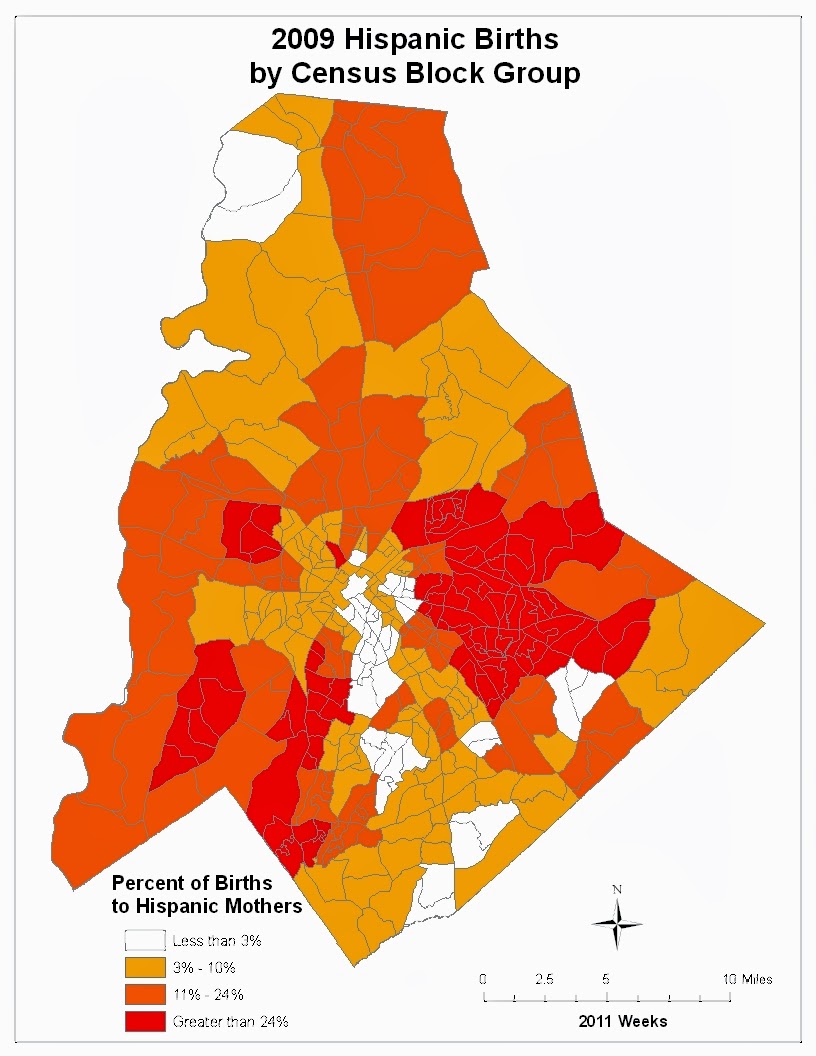
Births mean citizens, which mean future voters. District 9 goes outside Mecklenburg County so the fit is not perfect, but there are more and more Latinos being born in the district because they live in the suburbs. Here is a key point--district 9 avoids the city center, but there are few Latinos there anyway. Redistricting has never been aimed at them.
So we come to my own hypothesis, which is that redistricting works in the short term and backfires in the long term for Republicans.
Sunday, October 6, 2013
The Power of No in North Carolina

From Doonesbury. Not really the best way to get attention, unfortunately, though in fact North Carolina is gradually becoming purple rather than red. But it is, after all, the home of "Senator No" himself, Jesse Helms.
Wednesday, October 2, 2013
Job Opening for Latin American History
If you are a historian of modern (post-1930) Latin America then check out the position UNC Charlotte has.
This is a great place to work and the chair of History, Jurgen Buchenau, is a historian of the Mexican revolution and good friend of mine. If you're eligible you should apply!
The Department of History at the University of North Carolina at Charlotte invites applications for a tenure-track position as Assistant Professor in the field of modern Latin American History to begin August 2014. Applicants are required to have a Ph.D. in History or a related field at the time of appointment, show evidence of a strong potential for professional development as a scholar and teacher, and demonstrate a commitment to promoting diversity as a value in the department and college. A research and teaching focus on modern Latin American history is required, with an emphasis on the period since 1930. The field of specialization and the regional focus are open, although we particularly welcome applications from candidates interested in the areas of ethnicity/diaspora, human rights, environmental history, gender, and/or digital humanities.
This is a great place to work and the chair of History, Jurgen Buchenau, is a historian of the Mexican revolution and good friend of mine. If you're eligible you should apply!
Thursday, August 22, 2013
Obama and Higher Ed Privatization
On the exact same day, UNC system president Tom Ross sent out a budget memo and President Obama announced a policy for higher education.
From Ross:
From Obama:
The fact that Obama blames universities for increased student costs is frustrating. As I've written before, we've been cutting costs for a long time, but there is only so much you can do if you want to maintain quality. If state legislatures refuse to pay, then you get creeping privatization, i.e. students paying more.
As a parent of young children, I know the same is happening at the K-12 level. At public schools you are constantly asked for supplies and money, sometimes in large quantities, and far more than was requested when I was that age. If the schools are not given adequate budgets, then they begin de facto privatization.
If you approve of privatization, fine, but don't blame the schools for it.
From Ross:
For 2013-14, permanent funding reductions assigned to the UNC system total $115 million, or about 4.5% of our base operating budget.
From Obama:
“The bottom line is this: We’ve got a crisis in terms of college affordability and student debt,”
The fact that Obama blames universities for increased student costs is frustrating. As I've written before, we've been cutting costs for a long time, but there is only so much you can do if you want to maintain quality. If state legislatures refuse to pay, then you get creeping privatization, i.e. students paying more.
As a parent of young children, I know the same is happening at the K-12 level. At public schools you are constantly asked for supplies and money, sometimes in large quantities, and far more than was requested when I was that age. If the schools are not given adequate budgets, then they begin de facto privatization.
If you approve of privatization, fine, but don't blame the schools for it.
Tuesday, June 4, 2013
Immigration and NC Republicans
I may be beating a dead horse, but I find the Republican Party's internal debate on immigration reform so fascinating. Here is an op-ed about North Carolina by a former Republican County Chairman. It is specifically aimed at opposing driving permits for undocumented immigrants, but once again brings up the logical fallacies that plague restrictionist arguments.
The main problem is this:
The first is questionable, and the second is demonstrably wrong. One the first point, remember that George W. Bush got plenty of votes from Latinos, and the vote share went down only as the party became vocally anti-immigrant. Next, the critical issue for Republicans is not just gaining Hispanic votes per se, but rather making sure they actually have a base of support in 10-20 years. The share of whites in the population is decreasing, and alone cannot win national elections, especially at the presidential level.
Second, it is crystal clear that Republicans do support immigration reform. There is no evidence that I have to seen to suggest that "non-Hispanic conservatives" (read "whites") stop supporting the party as a result of voting for immigration reform.
It's like watching a car heading for a cliff, with some of the passengers arguing strenuously that putting on the brakes is a really terrible idea.
The main problem is this:
Voting for amnesty and other liberal immigration policies does NOT increase Hispanic votes for Republicans.
Voting for amnesty and other liberal immigration policies, however, significantly diminishes non-Hispanic conservative support for Republicans.
The first is questionable, and the second is demonstrably wrong. One the first point, remember that George W. Bush got plenty of votes from Latinos, and the vote share went down only as the party became vocally anti-immigrant. Next, the critical issue for Republicans is not just gaining Hispanic votes per se, but rather making sure they actually have a base of support in 10-20 years. The share of whites in the population is decreasing, and alone cannot win national elections, especially at the presidential level.
Second, it is crystal clear that Republicans do support immigration reform. There is no evidence that I have to seen to suggest that "non-Hispanic conservatives" (read "whites") stop supporting the party as a result of voting for immigration reform.
It's like watching a car heading for a cliff, with some of the passengers arguing strenuously that putting on the brakes is a really terrible idea.
Subscribe to:
Posts (Atom)